EDITOR’S SYNOPSIS
- Chairman Gautam Adani personally welcomed passengers from the inaugural flight and interacted with airport
staff, frontline workers and first-time flyers.
- NMIA commenced commercial operations on December 25, 2025, marking a major milestone for Mumbai’s aviation
ecosystem.
- NMIA is one of India’s largest greenfield airport projects delivered in record time by the Adani Group.
- Over 4,000 passengers handled on the first day of operations.
Mumbai, December 25, 2025: Navi Mumbai International Airport (NMIA) commenced commercial
operations today, marking a landmark expansion of Mumbai’s aviation capacity and a decisive step in
India’s infrastructure journey.
With NMIA now operational, Mumbai joins global aviation cities such as London, New York, Moscow, Tokyo
and Shanghai—each supported by multiple airports to meet rising demand. For the Mumbai Metropolitan
Region (MMR), this signals the start of a true multi-airport system designed for scale, resilience and
the future.
Developed and operated by Adani Airports Holdings Limited (AAHL), a wholly owned subsidiary of Adani
Enterprises Limited (AEL), NMIA is among India’s largest greenfield airport projects. Conceived to ease
congestion at Chhatrapati Shivaji Maharaj International Airport (CSMIA), the project underscores the
Adani Group’s ability to deliver complex, nation-building infrastructure in record time.
The inaugural commercial arrival—IndiGo flight 6E460 from Bengaluru—landed at 08:00 hours to a
traditional water cannon salute. On Day One, NMIA handled 48 flights connecting nine domestic
destinations, serving over 4,000 passengers, with peak traffic recorded between 05:00 and 07:00 hours,
reflecting strong early demand and operational readiness from the outset.
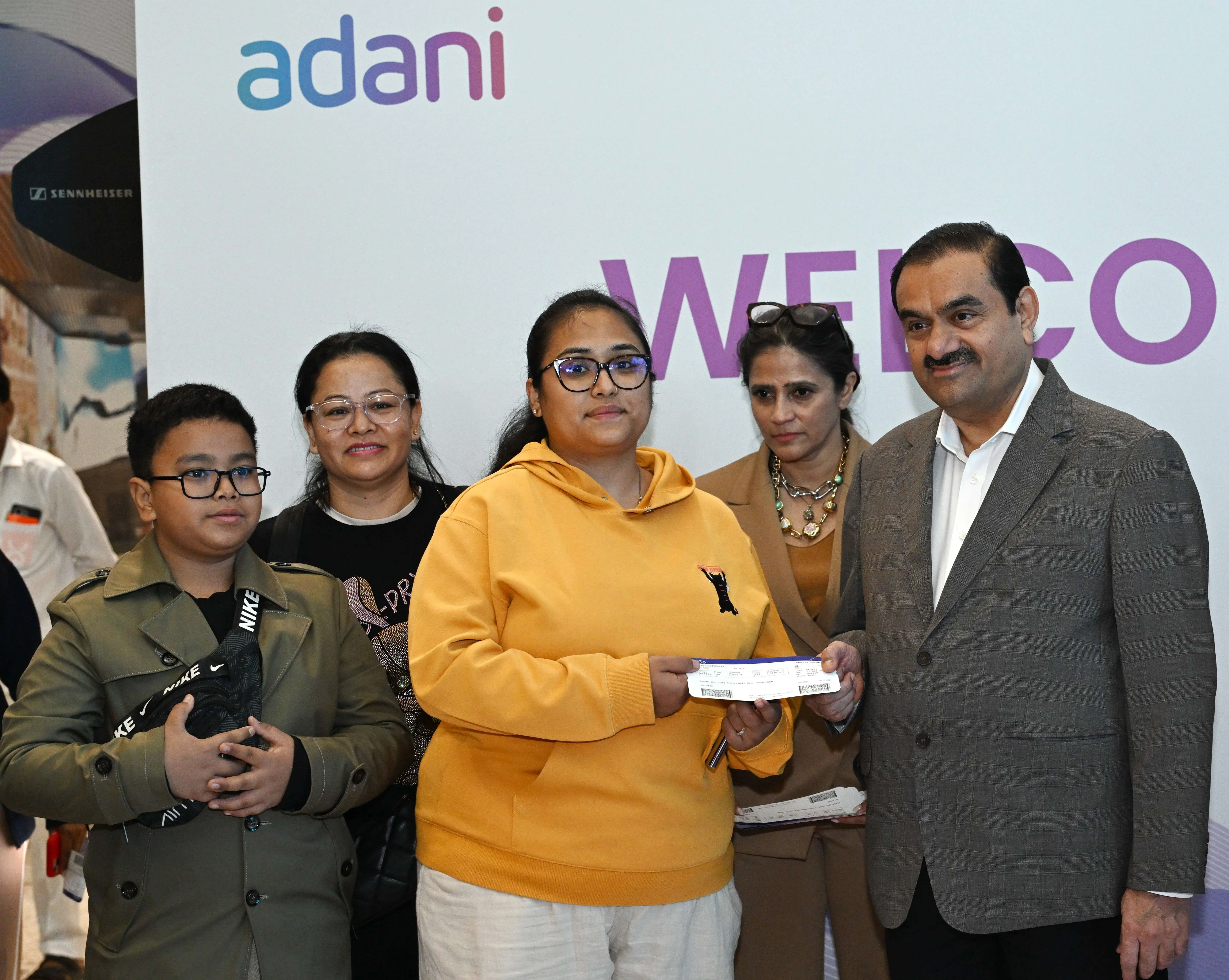
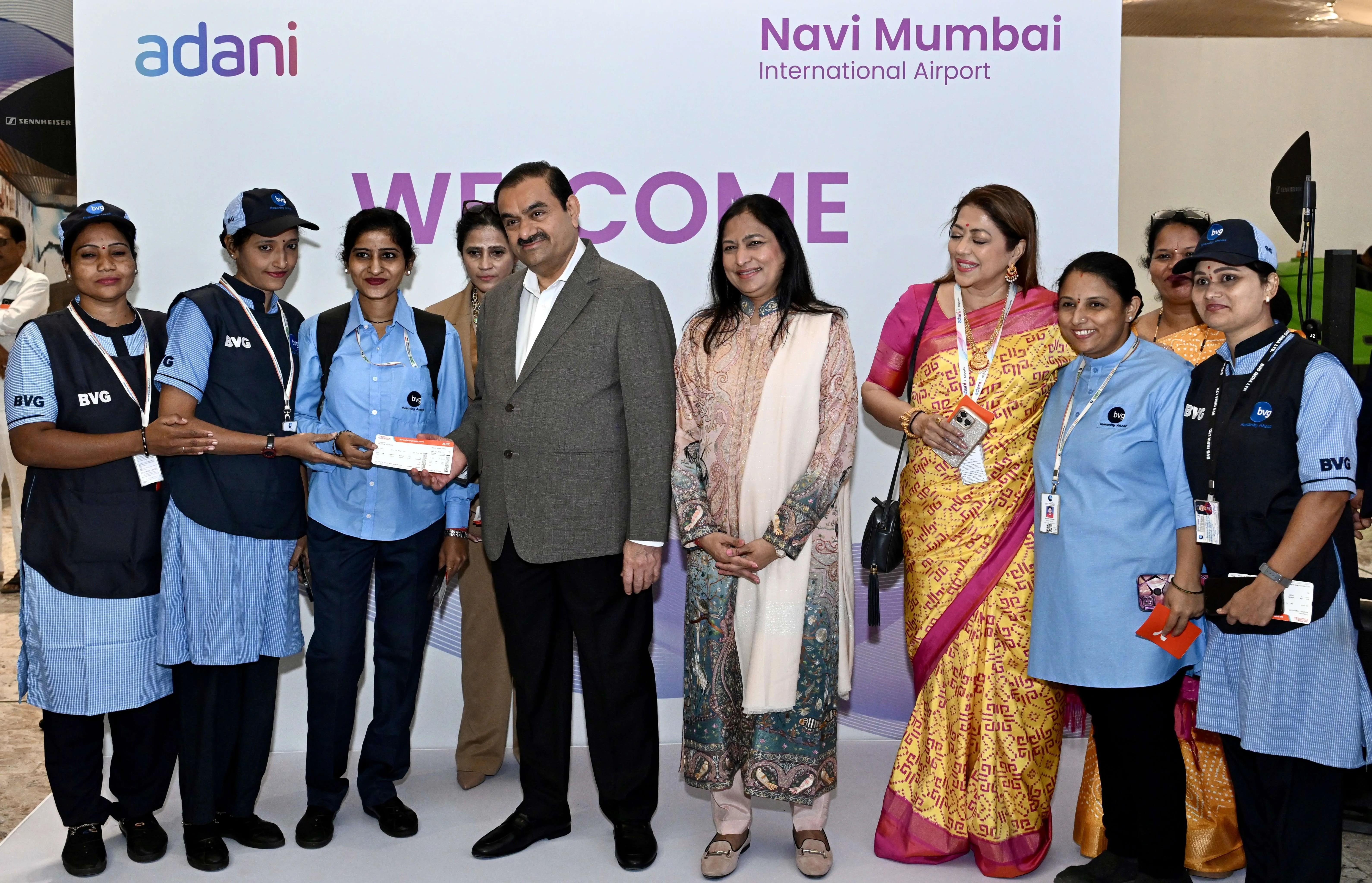
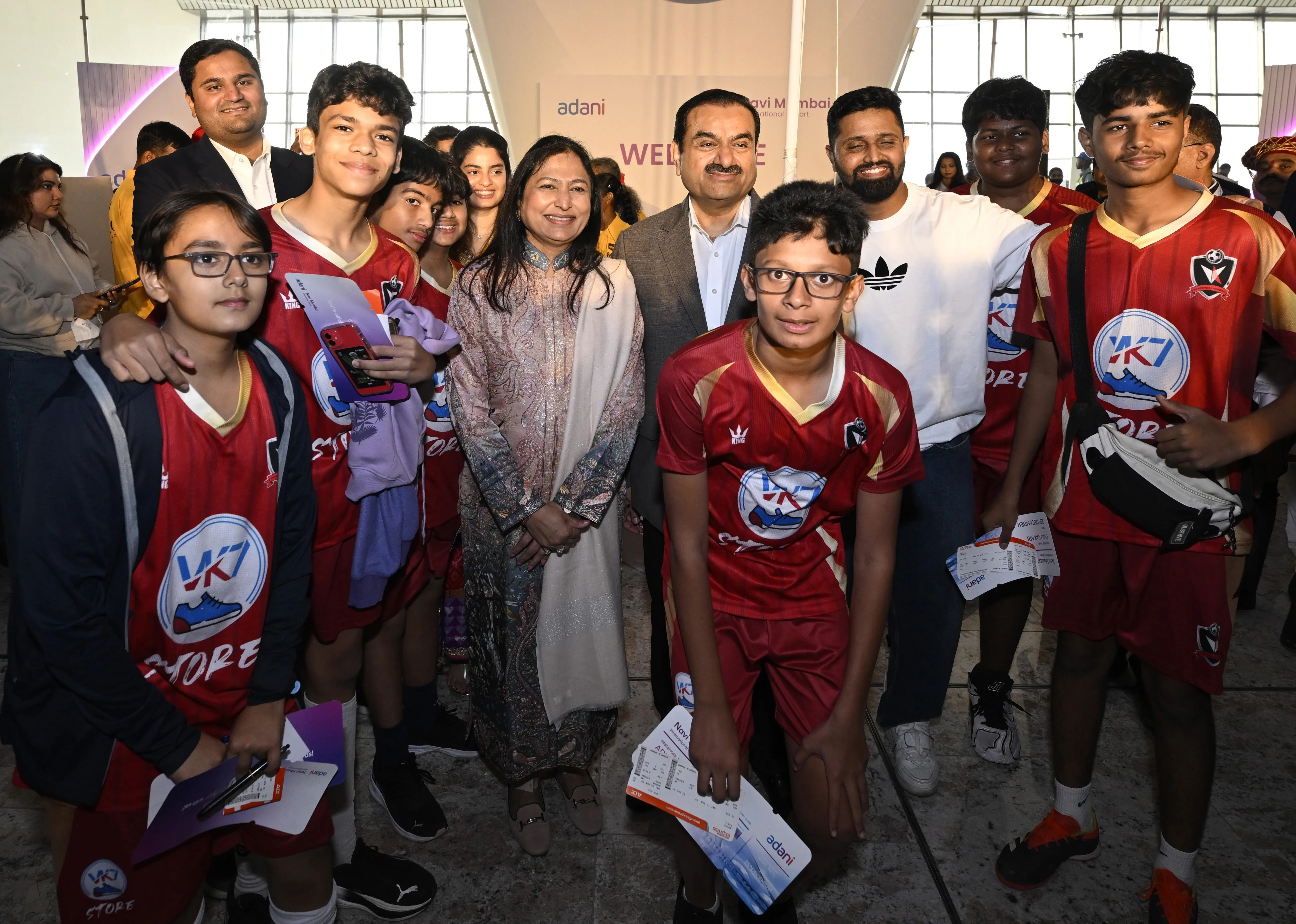
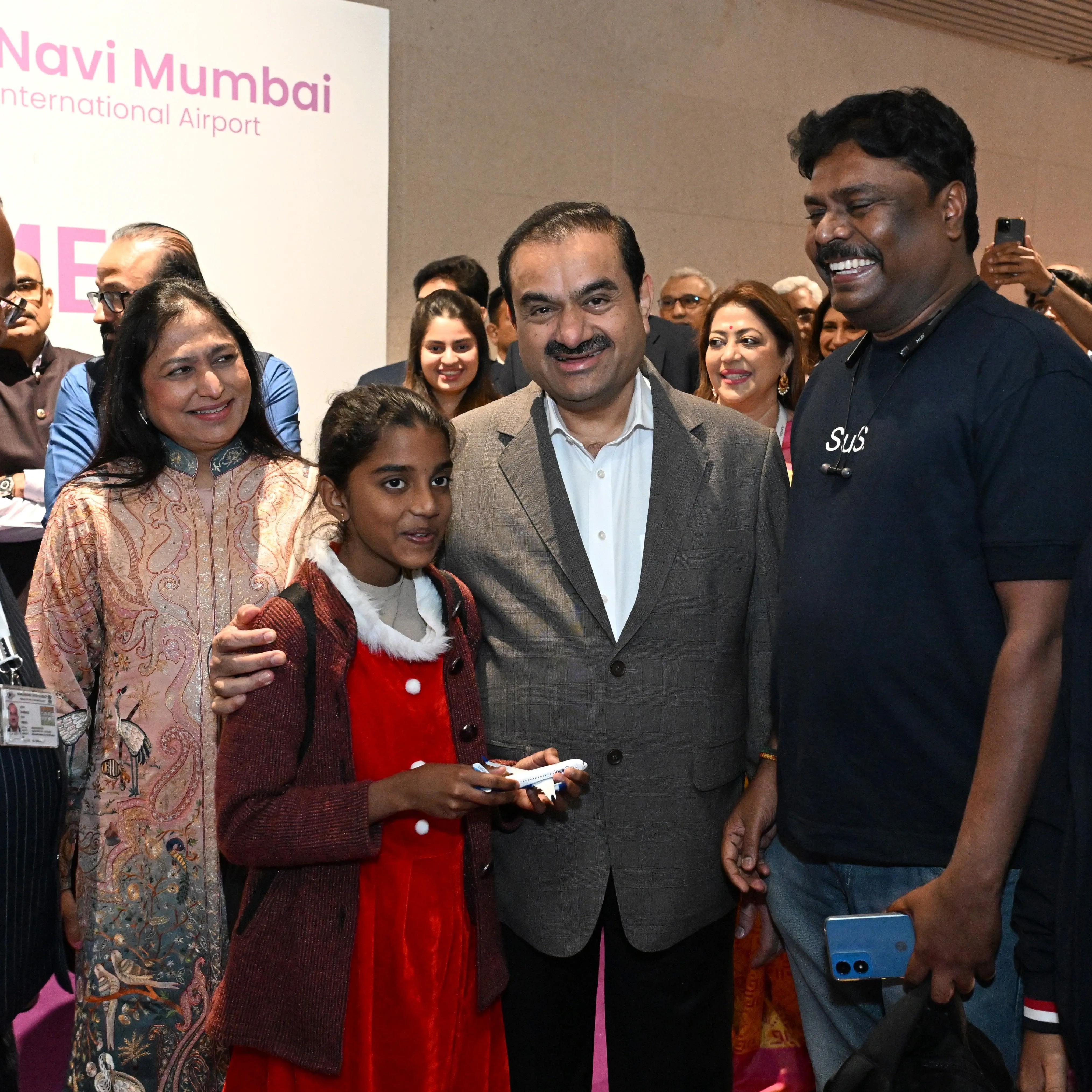
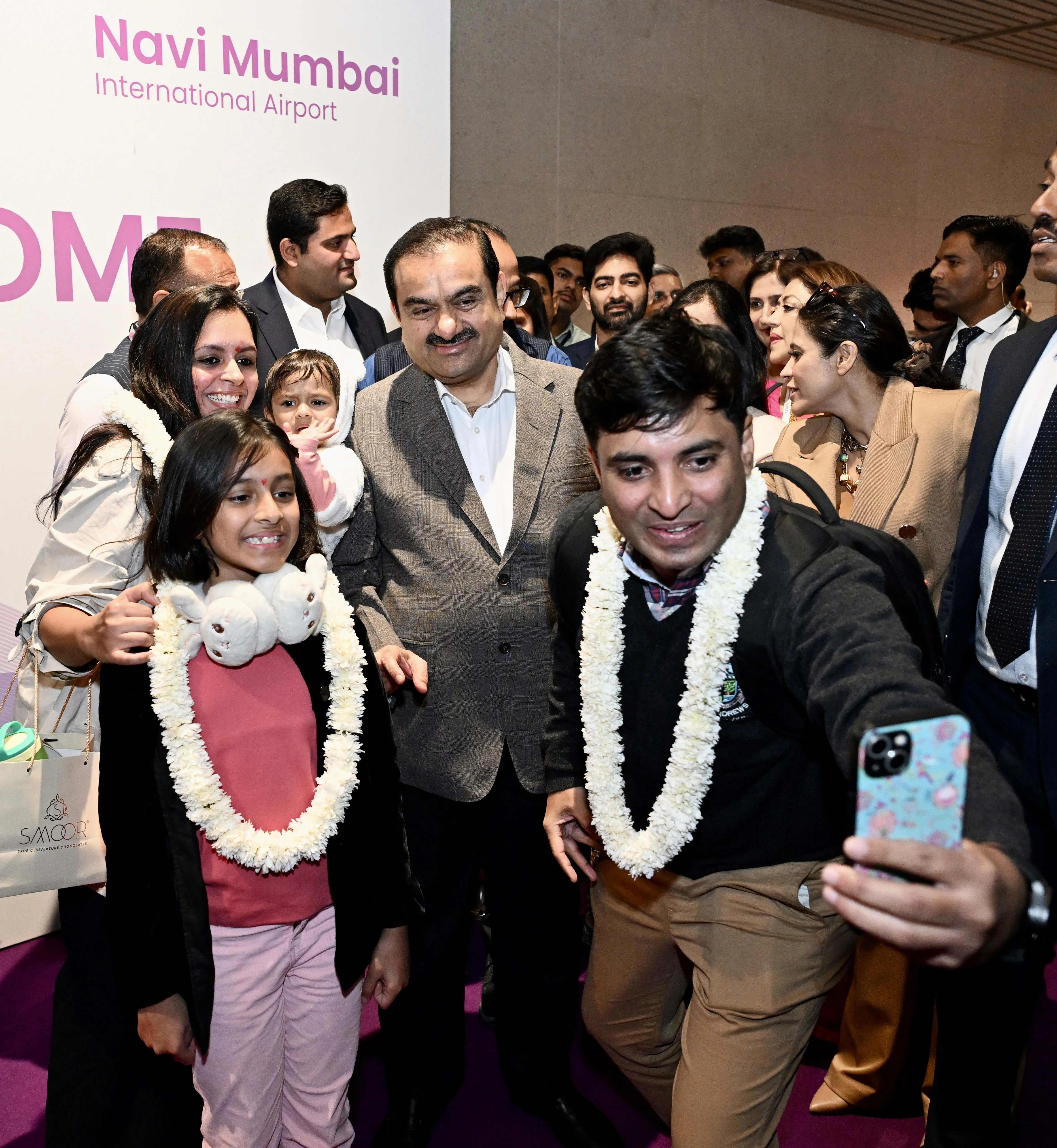
Chairman Gautam Adani personally welcomed passengers from the inaugural flight and
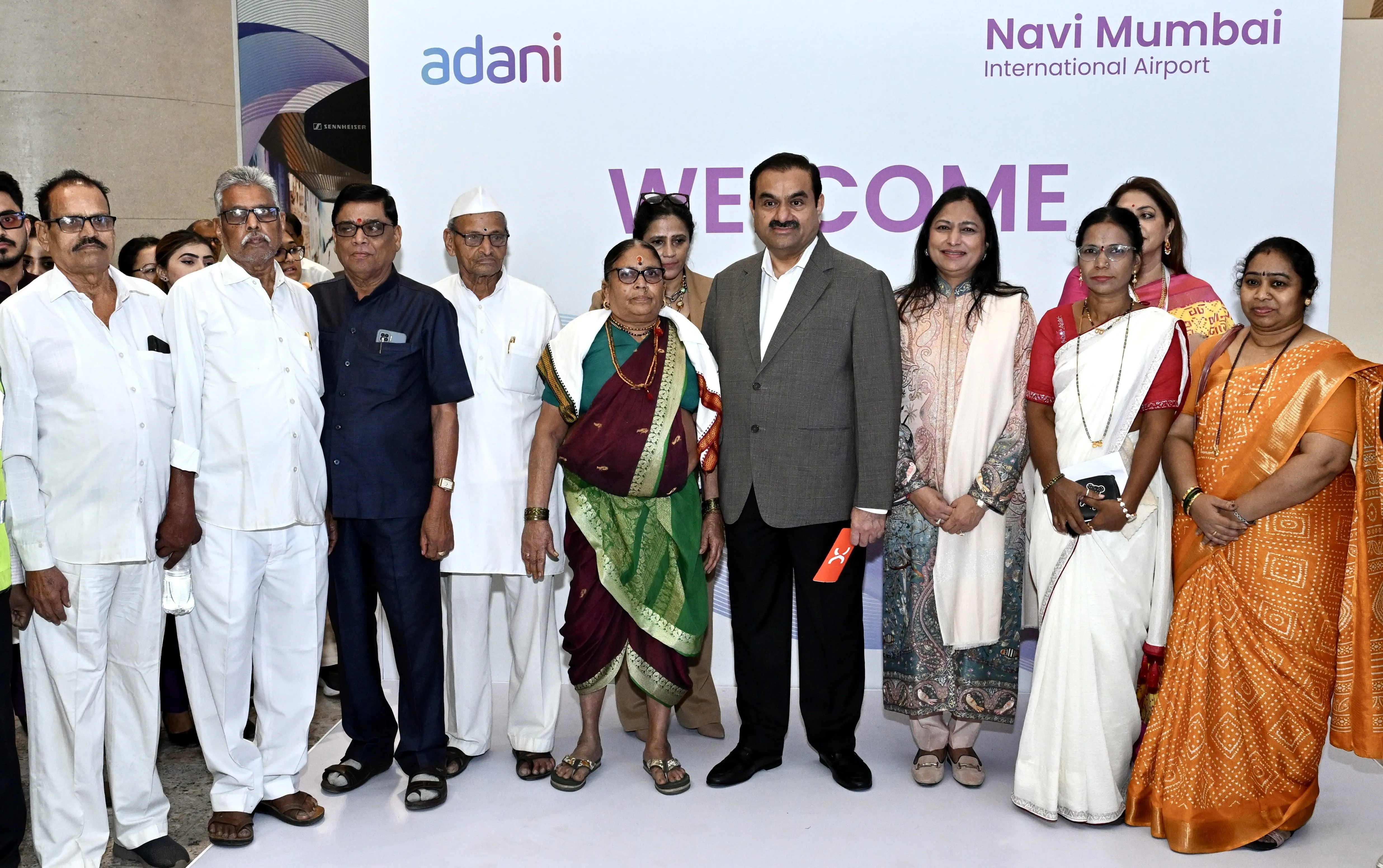
interacted with airport staff, frontline workers and first-time flyers. He later joined a ceremonial
walk through the departure terminal with airport employees, community representatives and Adani
Foundation beneficiaries. The launch concluded with a flag-hoisting ceremony led by Param Vir
Chakra awardees Captain Bana Singh and Subedar Major Sanjay Kumar, followed by the national anthem.
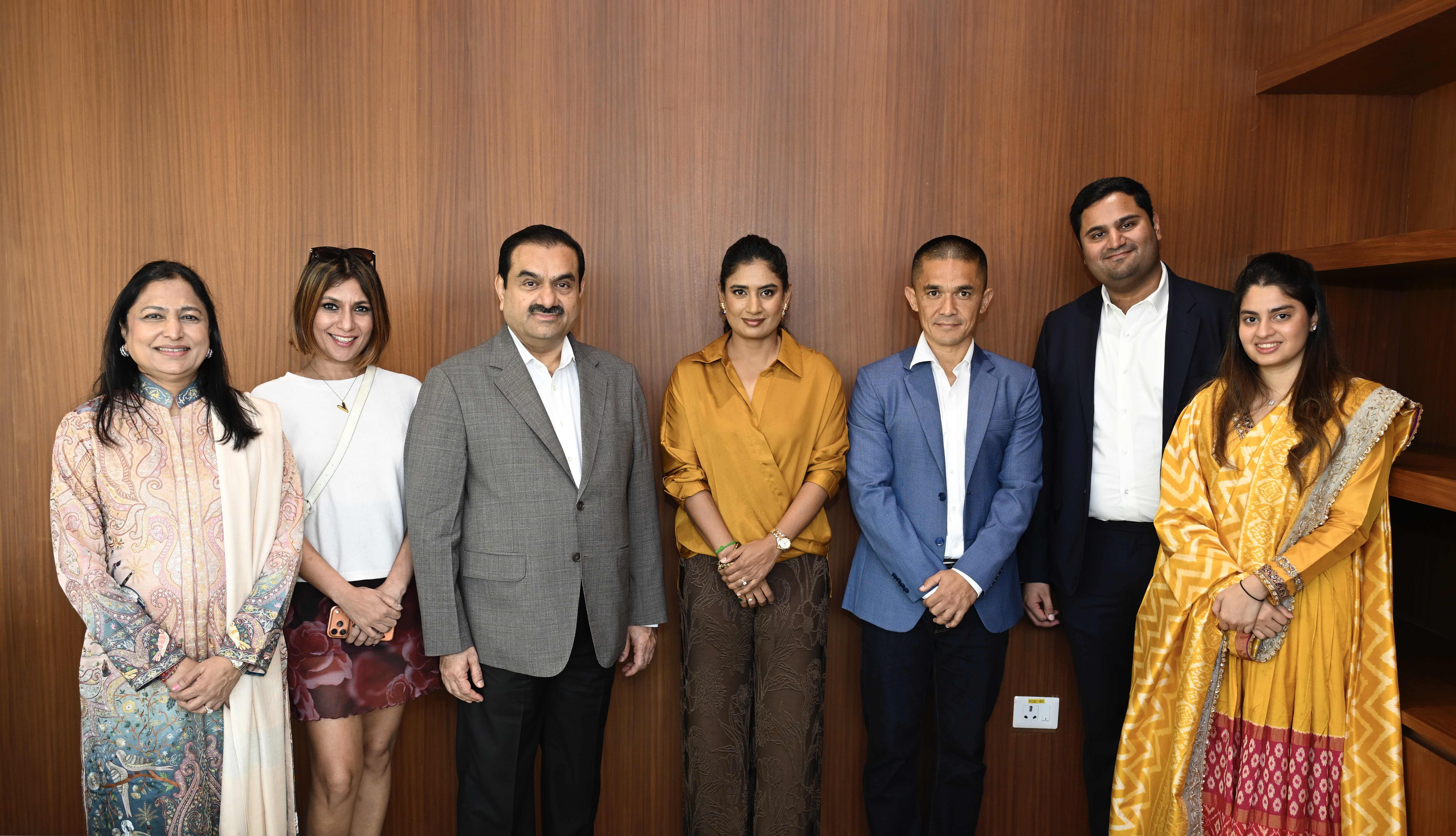
Leading sportspersons Suryakumar Yadav, Mithali Raj and Sunil Chhetri, along with social
influencers Malini Agarwal and Viraj Ghelani, were present.
Mr Adani said welcoming NMIA’s first passengers alongside the Param Vir Chakra awardees offered a glimpse
of India now taking shape. Standing with workers, farmers, social workers and colleagues with
disabilities, he said, captured the spirit of a nation moving forward with confidence and compassion.
Calling it “a proud day for Mumbai and for India,” he added that NMIA stands as a promise of what the
country can achieve when ambition is guided by purpose and delivered with speed and execution.
Airline leadership from IndiGo, Air India Express and Akasa Air participated in the launch, confirming
the start of scheduled departures from Navi Mumbai. Cultural performances featuring traditional
Maharashtrian Lezim (folk dance), Dhol (percussion drums) and Tutari (ceremonial wind instrument) added
a strong local flavour, offering visitors a vivid glimpse into Maharashtra’s cultural heritage. Farmers,
underprivileged families and colleagues with disabilities experienced their first-ever flight through a
special chartered aerial tour of Mumbai. India Post also released a commemorative First Flight Carried
Special Cover featuring the NMIA terminal, flown on an IndiGo service to Goa.
Jeet Adani, Director, AAHL, said NMIA establishes a resilient multi-airport system for
the MMR, boosting capacity, enhancing passenger experience and future-proofing the region’s aviation
growth.
On the eve of operations, NMIA’s skyline came alive with a drone spectacle featuring 1,515 synchronised
drones themed Rise of India. The display showcased a 3D lotus, the airport’s iconic design,
sustainability themes and a soaring aircraft, witnessed by young athletes, NMIA teams and community
members together.
A new gateway has opened.
With it, Mumbai and India look ahead with confidence, ready to rise and fly higher.
About Navi Mumbai International Airport Limited
Navi Mumbai International Airport Private Limited (NMIAL) is a special purpose vehicle established for
the
development, construction, operation, and maintenance of the greenfield international airport project at
Navi
Mumbai, Maharashtra. NMIAL is a Public Private Partnership (PPP) between Mumbai International Airport
Limited
(MIAL), a subsidiary of Adani Airports Holdings Limited (AAHL), which holds the majority stake of 74
percent, while
the City and Industrial Development Corporation of Maharashtra Limited (CIDCO), a Government of
Maharashtra
undertaking, holds the remaining 26 percent.
Navi Mumbai International Airport (NMIA) (IATA: NMI; ICAO: VANM), is set to become one of the busiest and most
significant aviation hubs in India. Located in Navi Mumbai, Maharashtra, NMIA is strategically positioned to cater
to the burgeoning air traffic demands of the Mumbai Metropolitan Region and Western India. Spanning over 1,160
hectares (2,866 acres), on completion, NMIA is designed to handle 90 million passenger per annum (MPPA). The airport
will feature two parallel runways, state-of-the-art terminal buildings, and advanced cargo facilities, ensuring
seamless passenger experience and efficient cargo handling. NMIA is set to be a greenfield airport with sustainable
and eco-friendly infrastructure, incorporating renewable energy sources and green building practices. The fluid and
futuristic design is influenced by the Lotus, India’s national flower.
In the initial phase, NMIA will have the capacity to manage 20 MPPA and 0.5 million metric tonnes of cargo
annually.
NMIA is committed to setting new benchmarks in operational efficiency, sustainability, and passenger satisfaction.
With its modern infrastructure and strategic location, NMIA is poised to become a prominent gateway to India and a
significant player in the global aviation industry.
Annexure
Twin Airport
Mumbai’s New Gateway Across the Harbour presents Navi Mumbai International Airport (NMIA) as a landmark development
that
will reshape the region’s travel and growth landscape. Rising over Ulwe near Panvel, the airport spans 1,160
hectares
and is designed to accommodate up to 90 million passengers annually in its full build-out, working in synergy in a
twin
airport System and easing pressure on Mumbai’s Chhatrapati Shivaji Maharaj International Airport (CSMIA) while
extending
connectivity to Thane, Pune, Raigad and the Konkan belt. With the Atal Setu offering a 20-minute link from South
Mumbai,
strengthened by the Sion–Panvel Highway, NMIA will be at the heart of an integrated transport network. Its creation
has
involved vast engineering efforts, from tunnelling hills to relocating villages. Already fuelling real estate,
logistics
and business expansion across Navi Mumbai, NMIA signals a shift in Mumbai’s economic gravity while offering
Maharashtra
a chance to showcase world-class infrastructure and balanced urban growth.
Airport Offerings
Set for inauguration soon, NMIA marks a transformative chapter for Mumbai’s aviation landscape. NMIA introduces a
twin-airport model alongside CSMIA, easing congestion and expanding connectivity through road, metro, suburban rail,
and
water links. Launching with Terminal 1, designed to handle 20 million passengers annually, blending cultural motifs
with
sustainable architecture and offering advanced check-in, security and baggage systems. Upon completion, the airport
will
feature four terminals with a cumulative 90 million annual passenger capacity and cargo facilities capable of 3.2
million tonnes annually will strengthen Mumbai’s global standing, creating an aviation ecosystem rivalling Dubai,
London, and New York.
A New Landmark
Navi Mumbai International Airport (NMIA), designed by Zaha Hadid Architects, draws inspiration from the lotus flower,
a
timeless symbol in Indian culture. NMIA's design showcases the terminal roof suggesting petals and the central
atrium
resembles a lotus pond. The airport's architecture aims to create a calming and intuitive environment for travellers
while embedding cultural meaning into a 21st-century modern, digital-first aviation hub. Like the lotus rising from
muddy waters, NMIA symbolises resilience and renewal for Mumbai and India. This cultural symbolism combined with
practical, sustainable features like passive cooling and natural light makes NMIA a landmark that redefines how
India
presents itself to the world.
Maharashtra's New Economic Engine
NMIA is set to transform Maharashtra's economy and infrastructure upon its inauguration. The airport will ease the
burden on CSMIA, which operates near capacity. NMIA is expected to handle 90 million passengers annually when fully
operational, nearly double the existing capacity of Mumbai. Experts predict NMIA will attract billions in foreign
and
private investments and boost Maharashtra's GDP by 0.5%. This will also spur real estate growth, with property
prices
appreciating by as much as 30% in key areas. The airport is also designed with sustainability in mind, incorporating
features like solar power and rainwater harvesting.
NMIA's Two-Decade Journey
Navi Mumbai International Airport (NMIA) is the result of nearly two decades of effort, beginning with the Union
Cabinet's approval in 2007 to relieve congestion at Mumbai's existing airport. The project navigated significant
hurdles between 2011 and 2017, including complex resettlement, environmental clearances, and engineering challenges.
In
2021, the Adani Group took over the Rs. 16,700 crore PPP, ensuring a single operator for Mumbai's twin-airport
system.
Construction accelerated following the land handover in 2022, with Zaha Hadid's lotus-inspired terminal design
unveiled
in 2023. After test landings in 2024. NMIA will initially handle 20 million passengers annually, positioning Mumbai
alongside global twin-airport cities.
New Frontiers in Air Freight
NMIA is designed as a logistics hub, with cargo as a core focus, capable of handling 0.5 million tonnes annually in
its
first phase. The airport is introducing several firsts in Indian air cargo, including a fully automated terminal
with AI
monitoring that can cut turnaround time by 40%. It also features a Pharma Excellence Centre with GDP-compliant cold
zones and a dedicated perishable cargo village. Crucially, NMIA’s proximity (20 km) to the Jawaharlal Nehru Port
Trust
(JNPT) creates an integrated logistics cluster for sea-air transshipment. This dual-engine strategy is expected to
support key sectors like agriculture and pharmaceuticals.
Retail Offerings
NMIA is shifting to a "passenger to product strategy" for non-aeronautical revenue, which can account for up to 40%
of
revenues at global hubs. The airport is designed to be a destination, not just a gateway. NMIA plans 110 retail and
Food
& Beverage (F&B) outlets, including 1,800 sq. m. of duty-free shops in both arrivals and departures. The strategy
includes creating experiential zones to increase passenger engagement and dwell time, and F&B offerings featuring
local
Mumbai concepts. The landside area will offer entertainment and dining zones accessible to non-passengers, expanding
the
customer base. With over 67 general aviation stands planned, NMIA is also targeting premium travellers. The aim is
to
bridge the gap with global non-aero revenue benchmarks.
NMIA: Lotus in Steel and Glass
NMIA, designed by Zaha Hadid Architects, is an engineering and cultural landmark rooted in the lotus flower metaphor.
The structure features a dual column system: 12 sculptural feature columns guide passenger movement and allow
natural
light to cascade through, while 17 robust mega columns support the immense lotus roof. This innovative system
creates
vast, open spaces, with the roof appearing to float above the terminal. The complex, curving design of the petals
required bespoke moulds and millimetre-level precision during construction. The roof is also performance-driven,
managing rainwater and reducing wind resistance, successfully merging cultural expression with practical engineering
for
passenger experience.